And Scientists Don’t Know Why
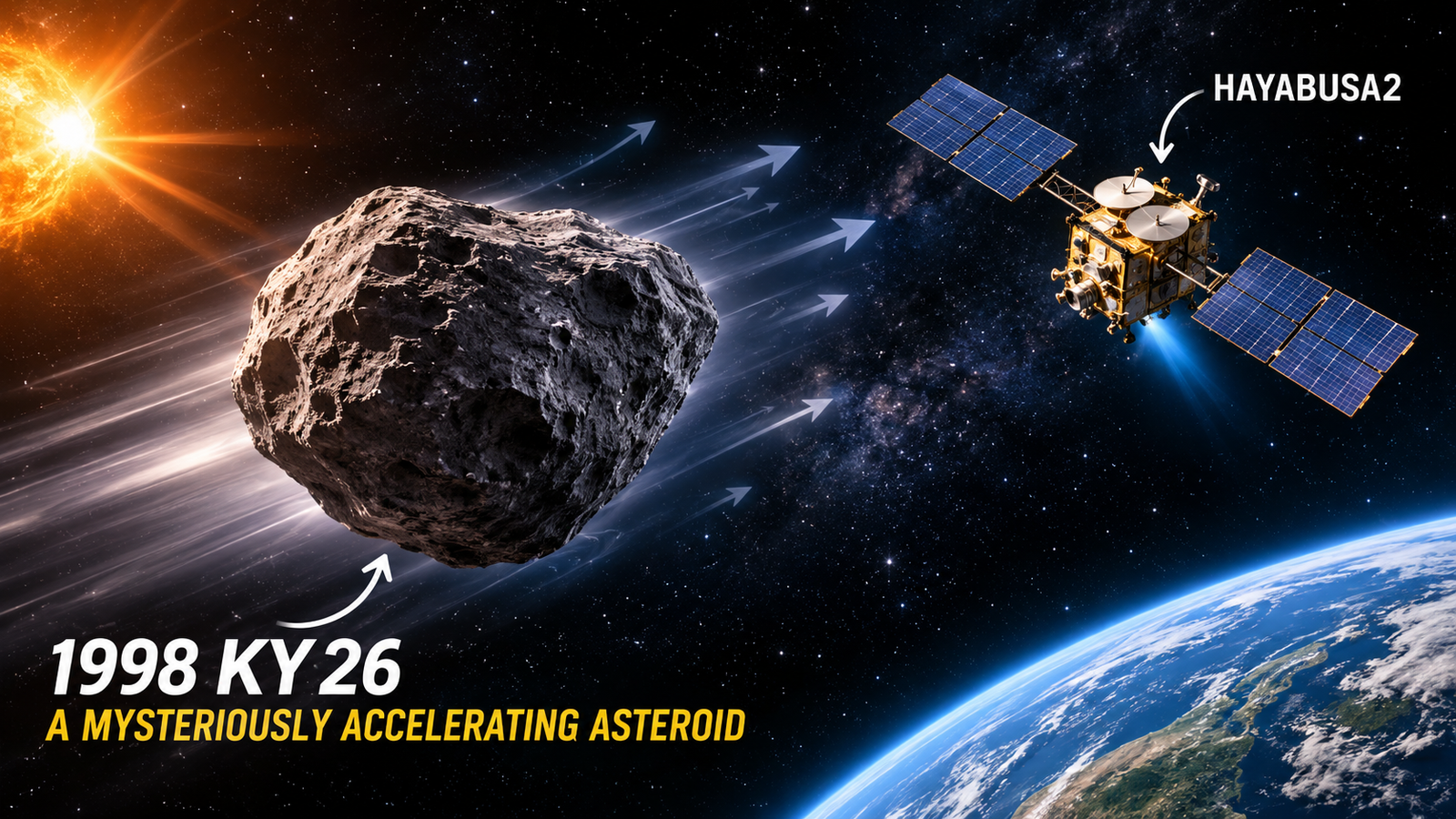
A tiny asteroid just 11 meters across is displaying an unusual acceleration that gravity alone cannot explain. Could it be releasing gas, responding to sunlight, or something else entirely? A Japanese spacecraft may finally help solve the mystery in 2031.
Space is full of surprises, but every now and then, astronomers discover something that challenges our understanding of how celestial objects behave.
One such mystery involves 1998 KY26, a small asteroid measuring approximately 11 meters in diameter. Despite its tiny size, this object has caught the attention of scientists because its motion appears to be changing in ways that cannot be fully explained by gravity alone.
Something seems to be giving this asteroid subtle pushes as it travels through space. But what could be responsible?
A study published in the scientific journal Icarus has raised new questions about one of the leading explanations. Researchers have been investigating whether 1998 KY26 could be a type of dark comet — an object that releases gas without producing the bright, visible tail typically associated with comets.
However, new calculations suggest that its temperatures may make this explanation difficult to sustain.
The mystery could eventually be solved by Japan’s Hayabusa2 spacecraft, which is scheduled to encounter the asteroid in July 2031.
Until then, scientists will have to work with observations, models, and competing theories to understand what is happening to this unusual space rock.
A Tiny Asteroid With an Extraordinary Rotation
At first glance, 1998 KY26 might not seem particularly impressive. Measuring just about 11 meters across, it is smaller than many buildings.
But this asteroid has a remarkable characteristic: it spins incredibly fast.
It completes one full rotation on its axis every 5.35 minutes. That means it rotates more than eleven times per hour, making it an especially interesting object for astronomers studying the physical properties of small asteroids.
Its rapid rotation is fascinating on its own, but the real mystery lies in its movement through space.
Scientists have identified an unusual acceleration that cannot be fully accounted for by the gravitational forces acting on the asteroid. Its motion suggests that another physical process may be influencing its trajectory.
For researchers, the challenge is identifying exactly what that process might be.
Why Is Asteroid 1998 KY26 Accelerating?
The movement of an asteroid is primarily governed by gravity. The Sun’s gravitational pull, along with the influence of other celestial bodies, determines the path it follows through space.
However, gravity is not the only force capable of changing an asteroid’s motion.
One possible explanation involves the release of gases from its surface — a process commonly associated with comets.
When a comet approaches the Sun, its surface heats up. As a result, frozen materials can transition directly from a solid state into gas through a process known as sublimation.
As this gas escapes into space, it produces a small reaction force. Over time, that force can act like a natural propulsion system, gradually changing the comet’s trajectory.
This phenomenon is particularly interesting because not all active objects develop the spectacular tails we usually associate with comets.
Some so-called dark comets appear to experience comet-like activity without displaying an obvious tail. Gas escaping from their surfaces can influence their motion even when traditional cometary features are difficult to detect.
Could 1998 KY26 be one of these objects?
It is an intriguing possibility, but there is a major problem with this explanation: the asteroid may simply be too warm to preserve the amount of ice required.
New Research Challenges the Dark Comet Hypothesis
To investigate whether water ice could survive inside 1998 KY26, researchers Korbin Hansen and Masatoshi Hirabayashi, from the Georgia Institute of Technology, developed a model based on the asteroid’s size, orbit, reflectivity, and likely composition.
Their research, published in Icarus, examined temperatures across different regions of the asteroid’s surface and interior.
The findings raised serious doubts about the possibility of long-term ice preservation.
According to the study, buried water ice would need to remain below approximately 145 kelvins (-128 °C) to survive over extended periods.
However, even the coldest regions of 1998 KY26 are estimated to experience average temperatures of at least 212 kelvins (-61 °C) throughout its orbit.
These conditions could make it extremely difficult for significant amounts of water ice to remain trapped inside the asteroid.
The researchers also calculated how quickly the ice could disappear under different scenarios.
If water ice accounted for approximately 1% of the asteroid’s total mass, the available material could be depleted in a little over 2,000 years.
But if gas escaping from the asteroid were responsible for its unusual acceleration, the ice reserves could run out in just 62 years.
That is a surprisingly short timescale for a process expected to explain the object’s current behavior.
Still, the researchers have not completely ruled out the presence of ice. One important uncertainty remains: scientists do not know exactly how long 1998 KY26 has been traveling along its current orbit.
The findings therefore weaken the dark comet explanation without eliminating it entirely.
Could Sunlight Be Pushing the Asteroid?
If escaping gases are not responsible for the acceleration, another possibility involves something much more familiar: sunlight.
It might seem strange to imagine that sunlight can push an asteroid through space. After all, light has no mass in the traditional sense.
However, photons — the particles that make up light — carry momentum. When they strike an object’s surface, they can transfer some of that momentum, producing a small force known as solar radiation pressure.
The force is extremely weak, but it can influence the motion of small objects over long periods.
Another possibility involves the Yarkovsky effect, a phenomenon in which an asteroid absorbs energy from sunlight and later releases some of that energy as heat.
Because this thermal radiation is not necessarily emitted equally in every direction, it can produce a tiny recoil force that gradually changes the asteroid’s orbit.
The effect depends on several factors, including the object’s rotation, surface properties, and thermal characteristics.
These mechanisms demonstrate how seemingly insignificant forces can have measurable consequences for small celestial bodies.
However, scientists still need more information before determining whether sunlight or another physical process is responsible for the unusual acceleration of 1998 KY26.
Hayabusa2: The Japanese Spacecraft Heading Toward the Asteroid
The biggest opportunity to solve this mystery may arrive in July 2031.
Japan’s Hayabusa2 spacecraft, developed by the Japan Aerospace Exploration Agency (JAXA), is scheduled to encounter 1998 KY26 during its extended mission.
The spacecraft previously made history by visiting the asteroid Ryugu and returning samples to Earth. Its next encounter will provide an opportunity to investigate another small and scientifically valuable object.
By observing 1998 KY26 up close, researchers hope to learn more about its composition, surface properties, rotation, and physical characteristics.
These observations could help determine whether the asteroid contains ice, whether it displays signs of gas release, and what mechanisms might be responsible for its unusual acceleration.
A close encounter could also provide valuable information about how small asteroids behave, particularly those with extremely rapid rotation.
For now, scientists must rely on remote observations and mathematical models. Hayabusa2 could provide the detailed measurements needed to test the competing explanations.
A Small Asteroid With a Big Mystery
At approximately 11 meters across, 1998 KY26 is hardly a giant among the objects traveling through our Solar System.
Yet its unusual acceleration and extraordinary rotation have made it a fascinating target for scientific investigation.
The dark comet hypothesis offers one possible explanation, but the asteroid’s estimated temperatures raise serious questions about whether enough ice could survive to produce the observed effect.
Solar radiation pressure and thermal forces such as the Yarkovsky effect offer alternative possibilities, although neither has yet provided a definitive answer.
The mystery is far from solved.
Scientists may have to wait until July 2031, when Hayabusa2 is expected to encounter the asteroid, before obtaining the detailed observations needed to understand what is happening.
Until then, this tiny space rock will continue traveling through the Solar System, carrying a question that researchers are still trying to answer:
What is really pushing asteroid 1998 KY26 through space?