A Controversial Theory Challenges Cosmic History
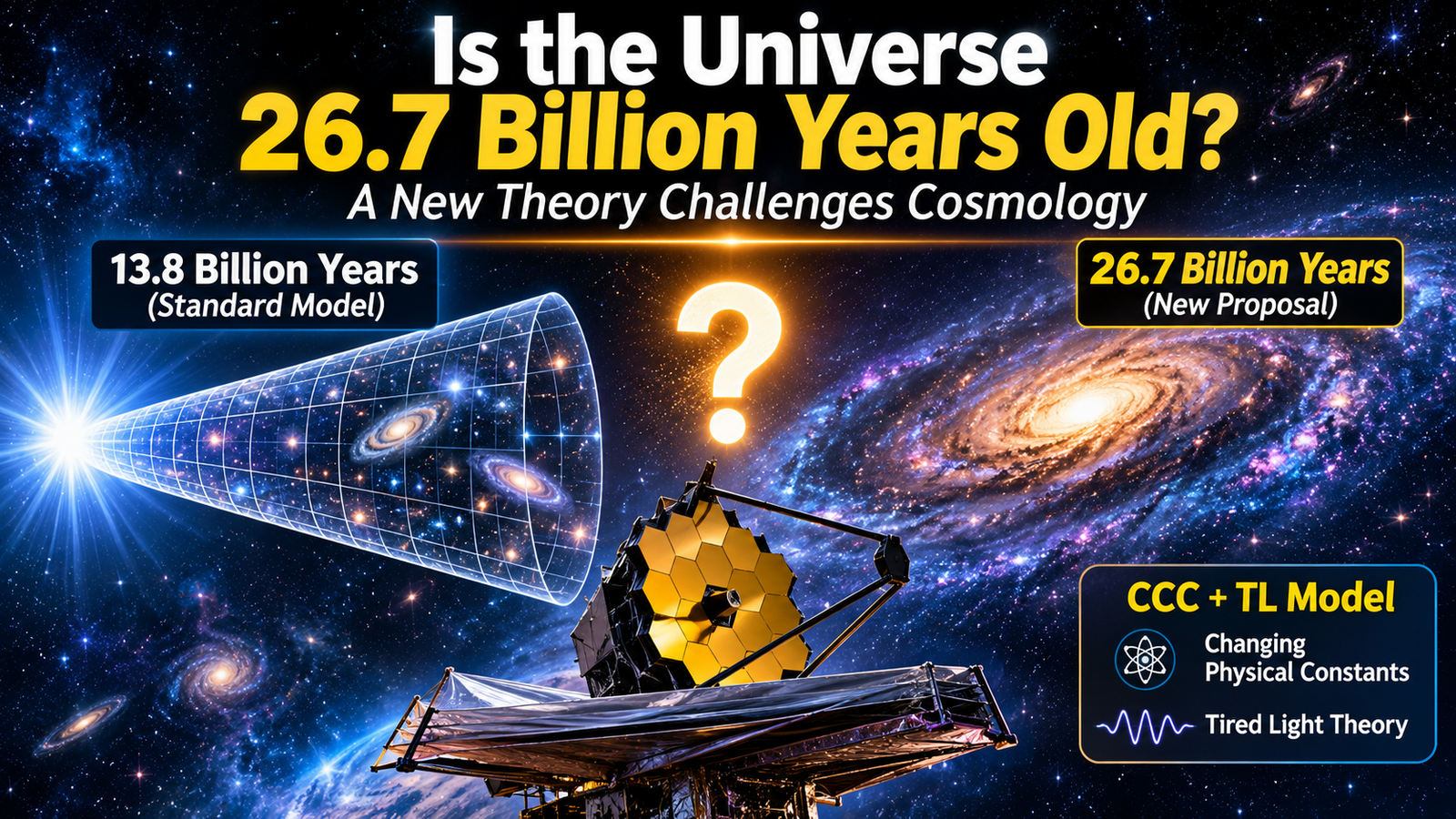
What if the universe were almost twice as old as scientists currently believe? A controversial cosmological model proposes that the cosmos may be 26.7 billion years old, potentially offering a new explanation for some of the surprisingly mature galaxies observed by the James Webb Space Telescope.
For decades, astronomers have worked with a widely accepted estimate: the universe is approximately 13.8 billion years old. This figure is one of the foundations of modern cosmology, supported by observations of the cosmic microwave background, the expansion of the universe, and other important evidence.
But what if that estimate is wrong?
A controversial alternative model developed by physicist Rajendra Gupta, from the University of Ottawa, suggests that the universe could be as much as 26.7 billion years old — nearly twice the age established by the standard cosmological model.
The proposal has attracted attention because it could help explain a puzzling discovery made by the James Webb Space Telescope (JWST): some galaxies in the early universe appear far more developed than scientists expected.
Could the cosmos have had much more time to build these enormous structures than current theories suggest?
A recent study published in the scientific journal Universe adds another piece to the discussion, reporting that the model can reproduce important predictions about the abundance of light elements formed shortly after the Big Bang.
However, this does not mean scientists have confirmed that the universe is older. The proposal remains highly controversial and faces many additional tests.
The James Webb Space Telescope Has Found a Cosmic Puzzle
One of the main motivations behind Gupta’s alternative model comes from observations made by the James Webb Space Telescope.
Launched in December 2021, JWST was designed to observe some of the earliest galaxies in the universe. Because light takes time to travel, looking at extremely distant objects also means looking back into the past.
In this way, the telescope allows astronomers to study galaxies that existed when the universe was still very young.
But some observations have raised unexpected questions.
Certain early galaxies appear surprisingly massive, bright, or structurally developed for the relatively short time available after the Big Bang. According to expectations based on standard cosmology, building such systems so early in cosmic history can be challenging.
It is a little like discovering a forest filled with enormous, centuries-old trees in a place where, according to your records, the seeds were planted only a few years ago.
There are two possible ways to approach the mystery: perhaps galaxies formed and evolved more efficiently than scientists previously thought, or perhaps the universe is older than current estimates indicate.
Gupta’s model explores the second possibility.
A Universe That Could Be 26.7 Billion Years Old
Gupta’s proposal combines two unconventional ideas in a framework known as Covarying Coupling Constants plus Tired Light, or CCC+TL.
The first part suggests that certain fundamental physical constants may change over cosmic history. These constants are normally treated as fixed in standard physical models, but Gupta’s framework explores what could happen if their values varied over time.
The second component involves an idea known as tired light.
In this hypothesis, light gradually loses energy as it travels through space. This would affect how astronomers interpret the light arriving from distant galaxies and, consequently, how they calculate cosmic distances and the history of the universe.
Together, these ideas produce a different interpretation of astronomical observations.
One particularly striking consequence is the amount of time available for galaxy formation.
Under the standard cosmological timeline, the universe was approximately 300 million years old during an early period when some surprisingly developed galaxies have been observed.
In Gupta’s model, the same cosmic era could correspond to a universe that was already around 4.6 billion years old.
That is a dramatic difference.
Instead of requiring galaxies to become remarkably developed in an extremely short period, the alternative model gives them billions of additional years to evolve.
In other words, structures that appear difficult to explain under the standard timeline could become more predictable in an older universe.
A New Test: Can the Model Explain the First Elements?
A cosmological theory cannot be judged only by whether it offers an attractive explanation for distant galaxies. It must also account for what happened during the earliest stages of cosmic history.
One of the most important tests involves Big Bang nucleosynthesis — the process through which the first light elements formed.
During the first few minutes after the Big Bang, the universe was hot and dense enough for nuclear reactions to produce elements such as hydrogen, helium, and small amounts of lithium.
The predicted proportions of these elements are a major test for cosmological models. Any alternative theory attempting to challenge the standard picture must explain how these ingredients came into existence.
In their recent study, Gupta and his collaborator Nikolaos Samaras report that the CCC+TL framework can reproduce important predictions for the abundances of these light elements.
This is a significant result for the researchers because it suggests that their model may be compatible with at least one important part of the universe’s early history.
However, passing one test does not establish that an entire cosmological framework is correct. The model still needs to demonstrate that it can explain the full range of observations that support modern cosmology.
Could We Explain Galaxies Without Dark Matter?
The CCC+TL model also raises questions about another major ingredient of the standard cosmological picture: dark matter.
Dark matter is an invisible form of matter that does not emit, absorb, or reflect light in the way ordinary matter does. Scientists infer its existence through its gravitational effects.
One important piece of evidence comes from galaxy rotation curves.
When astronomers measure how stars and gas move around the centers of galaxies, they find that many galaxies rotate in ways that cannot be explained by the gravitational pull of visible matter alone.
Dark matter provides a widely accepted explanation for this behavior. Its gravitational influence helps account for the unexpectedly high orbital speeds observed in the outer regions of galaxies.
Gupta’s framework proposes an alternative explanation for galaxy rotation behavior that does not require dark matter in the same way as the standard model.
If this approach eventually proves successful, it could have major implications for our understanding of how galaxies work.
But there is an important distinction: offering an alternative explanation for galaxy rotation curves is not the same as demonstrating that dark matter does not exist.
Dark matter is supported by several independent lines of astronomical evidence, including gravitational lensing, galaxy clusters, and the large-scale structure of the universe. Any competing model must account for all of these observations, not just selected phenomena.
What About the James Webb Telescope’s Next Discoveries?
The debate may become even more interesting as astronomers continue exploring the most distant reaches of the observable universe.
The James Webb Space Telescope has already transformed our understanding of early galaxy formation, but its observations are far from complete.
A particularly ambitious effort is the GLIMPSE program, which is intended to search for exceptionally distant galaxies, potentially at redshifts greater than 50.
If such objects are detected and their properties can be reliably established, they could provide new opportunities to test competing ideas about the early universe.
Gupta’s model suggests that galaxies may exist at distances beyond those currently explored by JWST.
Future observations could therefore help determine whether the CCC+TL framework makes predictions that match reality.
The key question is not simply whether astronomers can find more distant galaxies. It is whether the properties, distribution, and evolution of those galaxies are consistent with the predictions of the alternative model.
That distinction will be crucial.
Is the Standard Model of Cosmology About to Be Rewritten?
Not yet.
The standard cosmological model, commonly known as Lambda-CDM (ΛCDM), remains the leading framework for explaining the evolution and large-scale structure of the universe.
It combines general relativity with the effects of dark matter and dark energy and successfully accounts for a wide range of observations, from the cosmic microwave background to the distribution of galaxies across the cosmos.
The CCC+TL proposal is an alternative that challenges several assumptions behind this framework.
Although its reported results are interesting, the model has not yet demonstrated that it can reproduce the complete body of evidence supporting ΛCDM.
It must also face further observational and theoretical scrutiny. A successful explanation for early galaxies or light-element abundances is not enough on its own to overturn decades of cosmological research.
For now, the age of the universe remains approximately 13.8 billion years according to the standard model.
The proposed figure of 26.7 billion years is an alternative estimate advanced by Gupta and his collaborators, not an established scientific discovery.
A Much Older Universe Would Change Our Cosmic Story
If the universe really were 26.7 billion years old, the implications would be enormous.
Our understanding of galaxy formation, cosmic expansion, the evolution of stars, and the history of large-scale structures would need to be reconsidered.
Even the way we interpret observations from the James Webb Space Telescope could change dramatically. Rather than looking at galaxies formed during the universe’s earliest stages as we currently understand them, astronomers might be observing systems that had far more time to develop.
But that is still a hypothetical scenario.
The most important contribution of alternative models like CCC+TL may be the questions they force scientists to investigate. Unexpected observations are not necessarily signs that an established theory is wrong, but they can reveal where existing explanations need refinement or where new physics might be worth exploring.
For now, the universe remains 13.8 billion years old according to our best-supported cosmological model.
Whether it could be much older is a question that future observations and increasingly precise tests will help answer.
And if Gupta’s proposal survives those tests, our cosmic history could turn out to be far longer — and more complicated — than we ever imagined.