

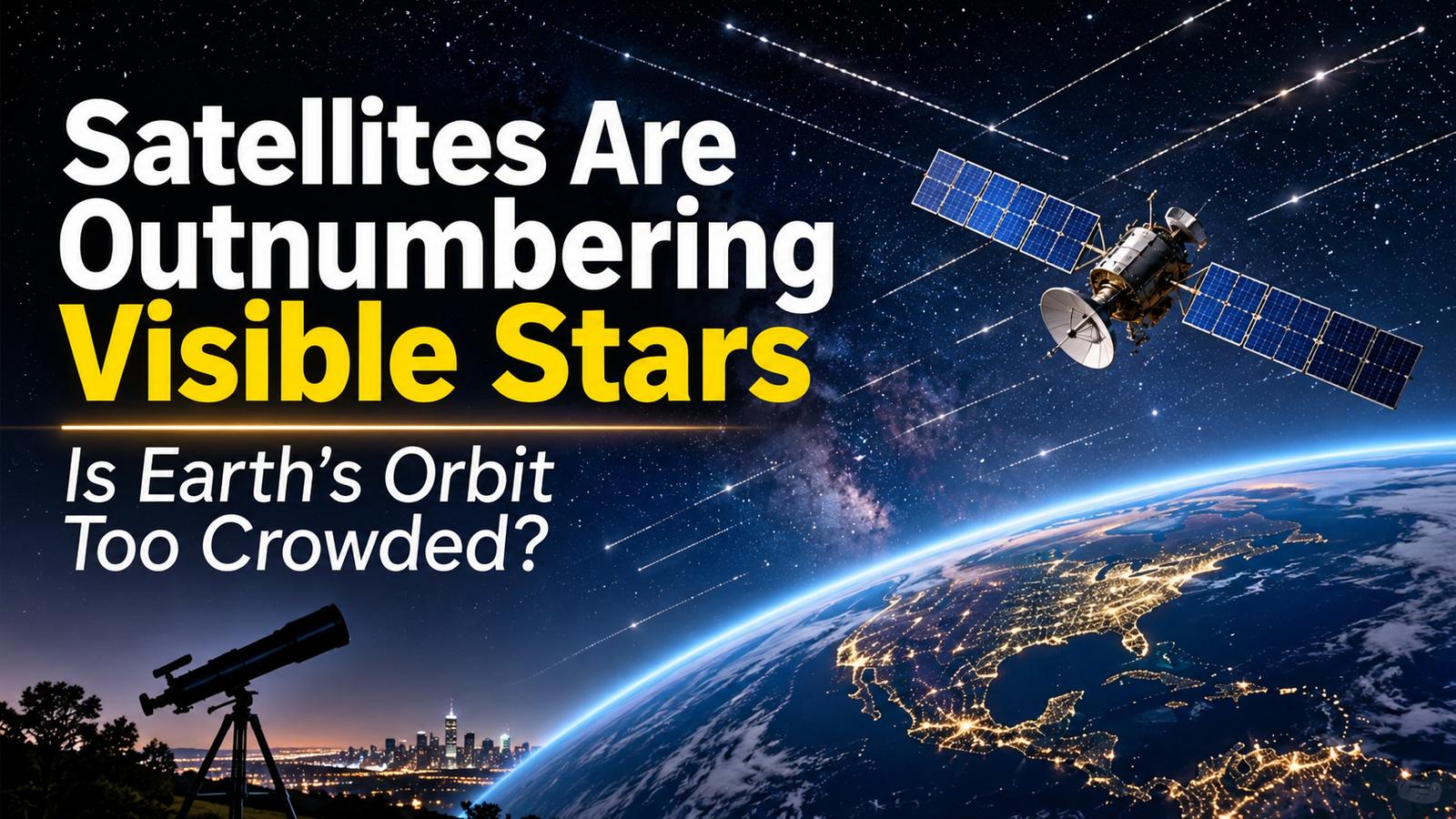
The night sky is changing. Thousands of satellites now cross Earth’s orbit, and in many cities, the number of spacecraft passing overhead can exceed the number of stars visible to the naked eye. As satellite constellations expand and space debris continues to accumulate, astronomers and space agencies face a growing challenge: how can humanity explore space without making it increasingly difficult and dangerous to use?
For thousands of years, people have looked up at the night sky and admired its stars. Today, however, that familiar view is beginning to change.
A growing number of artificial satellites are moving across Earth’s orbit, creating bright trails in astronomical images and adding unwanted light to the night sky. In some locations, these spacecraft may already outnumber the stars visible to the naked eye.
A recent analysis of 15,833 active satellites in low Earth orbit suggests that more than 700 satellites can be above a typical mid-latitude city at the same time. Although not all of them are visible, the numbers reveal how dramatically human activity in space has expanded.
And satellites are only part of the problem. Thousands of inactive spacecraft, discarded rocket stages, and countless fragments of debris are also circulating around Earth.
Together, these developments raise an important question: are we beginning to overcrowd the space around our planet?
More Than 700 Satellites Over a Single City
A study conducted by engineering company Accu Components examined the distribution of 15,833 active satellites in low Earth orbit. Using tracking information from the U.S. Space Force, available through the CelesTrak website, researchers analyzed satellite trajectories recorded on October 12 and 18.
The results were striking.
Under ideal observing conditions, with a completely unobstructed horizon, the researchers estimated that approximately 710 satellites could cross the sky over a medium-sized British city at any given moment during the night.
Across an entire night, as many as 12,891 different satellites could pass over the same region.
The analysis focused on the United Kingdom, but the researchers suggested that similarly intense satellite traffic occurs across much of Europe, the United States, and other regions located between approximately 40 and 50 degrees north or south latitude.
The concentration is not uniform around the planet. Many Starlink satellites operate in orbital inclinations of approximately 53 degrees, contributing to heavier traffic at mid-latitudes. Near the equator, the estimated number of satellites overhead is lower, at around 490.
It is important to note that the analysis was not peer-reviewed, and its global estimates are approximate. Nevertheless, it illustrates the scale of the growing satellite population.
Are There Really More Satellites Than Stars?
The comparison sounds almost unbelievable, but there is an important distinction between satellites passing overhead and satellites that can actually be seen.
Unlike stars, satellites do not produce their own visible light. They become visible when they reflect sunlight toward observers on the ground.
This means that a satellite can be passing directly overhead without being visible, especially when it is in Earth’s shadow.
According to the Accu Components analysis, an average of approximately 105 out of the 710 satellites overhead at a given moment may be illuminated and bright enough to appear in the night sky.
That number changes considerably throughout the night.
During the first hour after sunset, approximately 300 satellites may be illuminated. Around midnight, the number can fall to fewer than 20, before rising again to approximately 300 in the hours before sunrise.
Even these smaller numbers can be significant when compared with the number of stars visible from urban environments.
In heavily light-polluted cities such as London and New York, only a few dozen stars may be visible to the naked eye. In smaller cities and suburban areas, observers may see several hundred. Thousands of stars generally require much darker locations, such as remote rural regions or isolated mountains.
As a result, even a fraction of the satellites overhead can compete with the stars that people are able to see.
How Satellite Constellations Are Changing Astronomy
The rapid growth of satellite constellations has been driven largely by the demand for global internet connectivity.
One of the best-known examples is Starlink, operated by SpaceX. Its network consists of thousands of satellites designed to provide broadband internet services across the world.
Other companies and organizations are also planning large satellite networks, with proposals involving hundreds of thousands or even millions of spacecraft over the coming decades.
These systems offer important technological benefits, including internet access in remote regions and improved global communications.
However, their expansion has raised concerns among astronomers.
When satellites cross the field of view of a ground-based telescope, they can leave bright streaks across astronomical images. These trails may interfere with observations, obscure distant galaxies, and make it more difficult to identify faint objects.
The problem is especially serious for surveys that repeatedly photograph large areas of the sky.
Satellites can also contribute to the overall brightness of the night sky by reflecting sunlight. This additional artificial light can reduce the contrast between celestial objects and the background sky, making faint astronomical targets harder to observe.
For researchers studying distant galaxies, asteroids, and other faint objects, even small increases in background brightness can make a difference.
The concern is not simply that there are more moving lights in the sky. It is that the expanding satellite population could gradually make some of the most important astronomical observations more difficult.
The Other Threat: Space Debris
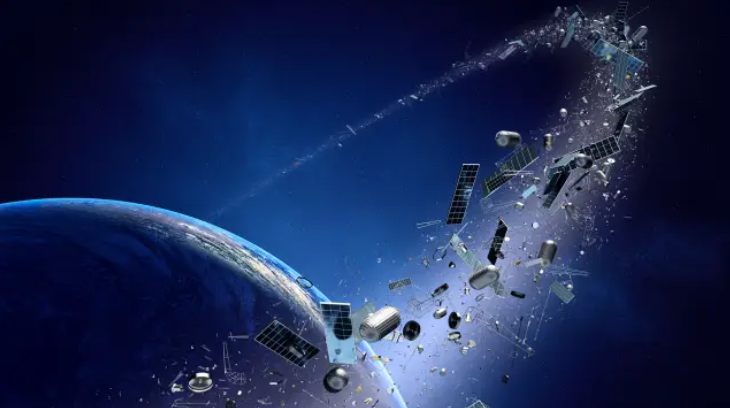
While active satellites are changing the appearance of the night sky, another problem is developing largely out of sight.
Space debris, also known as orbital debris or space junk, includes inactive satellites, discarded rocket stages, fragments from collisions, and other human-made objects that remain in orbit around Earth.
During the early decades of space exploration, there was relatively little concern about what would happen to spacecraft after their missions ended. Many objects were simply left in orbit.
Over time, however, the number of launches increased, and so did the amount of material abandoned around our planet.
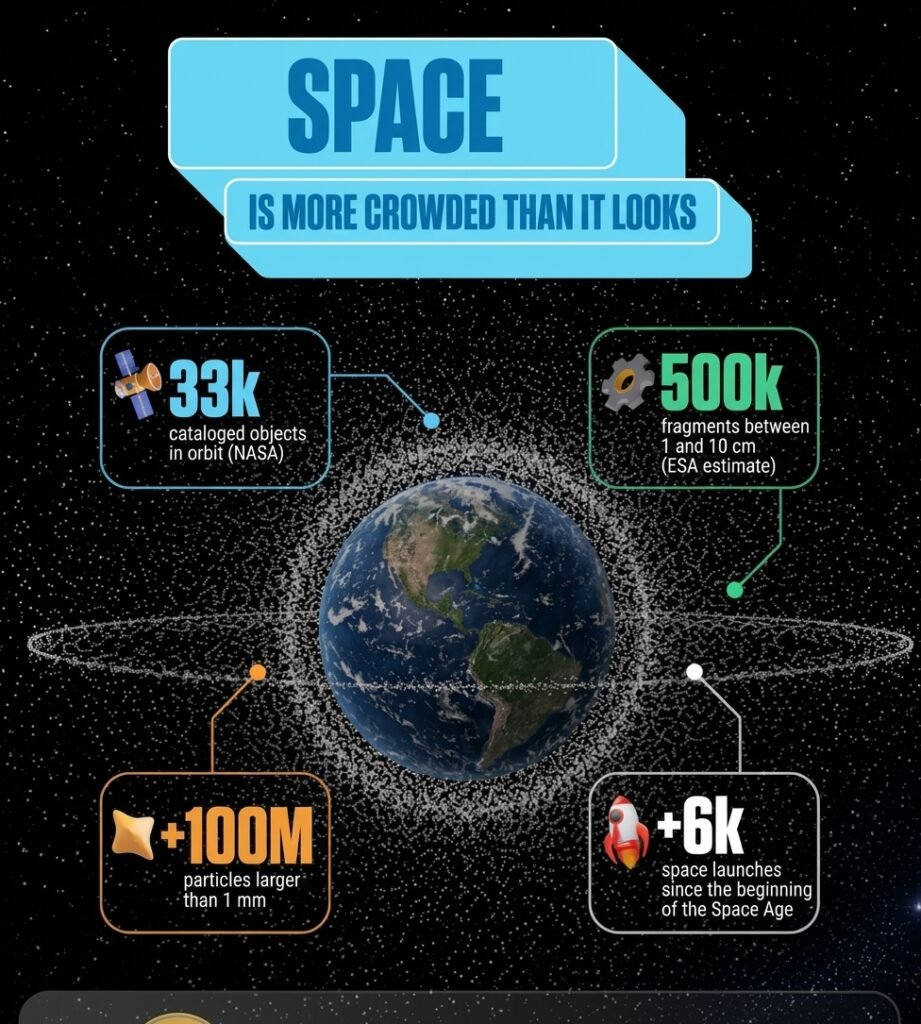
According to figures cited by NASA in the source material, 33,098 objects had been cataloged in Earth’s orbit, including spacecraft, rocket bodies, and identified debris.
But the actual population is believed to be much larger.
Estimates from the European Space Agency indicate that there may be approximately 500,000 fragments measuring between 1 and 10 centimeters, along with more than 100 million particles larger than 1 millimeter.
Many of these fragments are too small to be tracked individually, yet they can still damage or destroy operational spacecraft.
And the danger comes from their extraordinary speed.
Why Tiny Fragments Can Destroy Satellites
Objects in low Earth orbit travel at speeds of several kilometers per second. At these velocities, even a tiny fragment can carry enormous kinetic energy.
A particle measuring only a few millimeters may cause serious damage if it strikes a spacecraft.
According to Antonio Bertachini, a researcher associated with Brazil’s National Institute for Space Research (INPE), even a small piece of paint detached from a satellite can carry enough energy to cause catastrophic damage under certain impact conditions.
This is why space debris represents such a serious threat.
A collision between two large objects can also generate thousands of additional fragments, increasing the risk of further impacts.
This creates a dangerous chain reaction: more debris increases the probability of collisions, and collisions produce even more debris.
The phenomenon is associated with the Kessler Syndrome, a scenario in which collisions between objects in orbit could generate enough debris to make certain orbital regions increasingly hazardous for future missions.
Although this is not an inevitable outcome, the growing concentration of objects makes collision prevention and debris reduction increasingly important.
Satellites Are Now Designed With Their Final Journey in Mind
The growing debris problem has forced the space industry to rethink how satellites are designed and operated.
In the past, engineers concentrated primarily on making spacecraft function successfully during their missions. Today, planning increasingly includes what happens when a satellite reaches the end of its operational life.
One important recommendation is to remove inactive satellites from orbit as quickly as possible.
For years, a guideline allowing satellites to remain in low Earth orbit for up to 25 years after completing their missions was widely used. More recent recommendations have moved toward a much shorter period, often around five years.
Depending on the spacecraft and its orbit, this can involve a controlled reentry into Earth’s atmosphere or another disposal strategy.
Engineers are also developing satellites designed to break apart more easily during atmospheric reentry, increasing the likelihood that their components will burn up before reaching the ground.
Some spacecraft reserve fuel specifically for collision-avoidance maneuvers and end-of-mission disposal.
These changes reflect a fundamental shift in space engineering: a satellite’s life cycle must be considered from launch to final disposal.
How Do Space Agencies Prevent Collisions?
Avoiding collisions requires constant monitoring.
The U.S. Space Force operates the Space Surveillance Network (SSN), a system of radar installations and optical sensors that tracks large numbers of objects orbiting Earth.
The information helps satellite operators identify potential close approaches and determine whether a spacecraft needs to perform an avoidance maneuver.
Other organizations and countries also contribute to space surveillance, sharing information and developing systems to improve orbital safety.
Brazil participates in this international effort through the National Institute for Space Research.
INPE monitors the orbits of satellites under its responsibility and uses information provided by international tracking networks to assess collision risks.
According to the researchers cited in the source material, INPE receives an average of one or two collision alerts per month. Avoidance maneuvers are carried out approximately once every three months.
However, these maneuvers come with a cost.
A satellite has a limited amount of fuel, and every adjustment consumes some of that supply. The more often a spacecraft needs to change its trajectory, the more its operational lifetime may be affected.
In an increasingly crowded orbital environment, collision avoidance is becoming a routine part of satellite operations.
Can We Clean Up Earth’s Orbit?
Preventing new debris is essential, but what about the objects that are already there?
Researchers around the world are investigating technologies designed to remove inactive satellites and other large pieces of debris.
Some proposed solutions include robotic arms capable of capturing abandoned spacecraft, harpoons that can attach to large objects, specialized cables, and dedicated vehicles designed to collect debris and guide it toward atmospheric reentry or safer disposal orbits.
These technologies are still developing, and removing objects from orbit presents significant technical and financial challenges.
A spacecraft designed to capture debris must be able to locate its target, approach it safely, and deal with objects that were never designed to be retrieved.
For now, the most practical strategy remains preventing the creation of additional debris in the first place.
Better satellite design, responsible end-of-life disposal, improved tracking, and international cooperation will all be essential to keeping Earth’s orbital environment usable.
The Future of Space Depends on Keeping It Sustainable
Humanity is entering an era in which Earth’s orbit is becoming increasingly important.
Satellites support communications, navigation, weather forecasting, environmental monitoring, scientific research, and countless services used in everyday life.
At the same time, the rapid expansion of satellite constellations is creating new challenges for astronomy and increasing the complexity of orbital traffic management.
The night sky is a shared scientific and cultural resource, while Earth’s orbital environment is a limited space that must remain safe for future missions.
The challenge is not to stop exploring space or to abandon the benefits of satellite technology. It is to make sure that technological progress does not compromise the very environment that makes these activities possible.
As satellite numbers continue to rise, responsible design, effective disposal, and international cooperation will become increasingly important.
Space may seem infinite, but the useful orbits around Earth are not.
And if humanity wants to keep exploring the cosmos, it must first learn how to take better care of the space immediately surrounding our planet.
Credits: Ministry of Science, Technology and Innovation of Brazil


Ebony porn runs wide here: bubble ass rides, wet
pussy creampies, homemade thots, BBC dick anal, and oiled
babes in hard scenes. ebony teen clip https://playovni.com/caitlyn3123119