

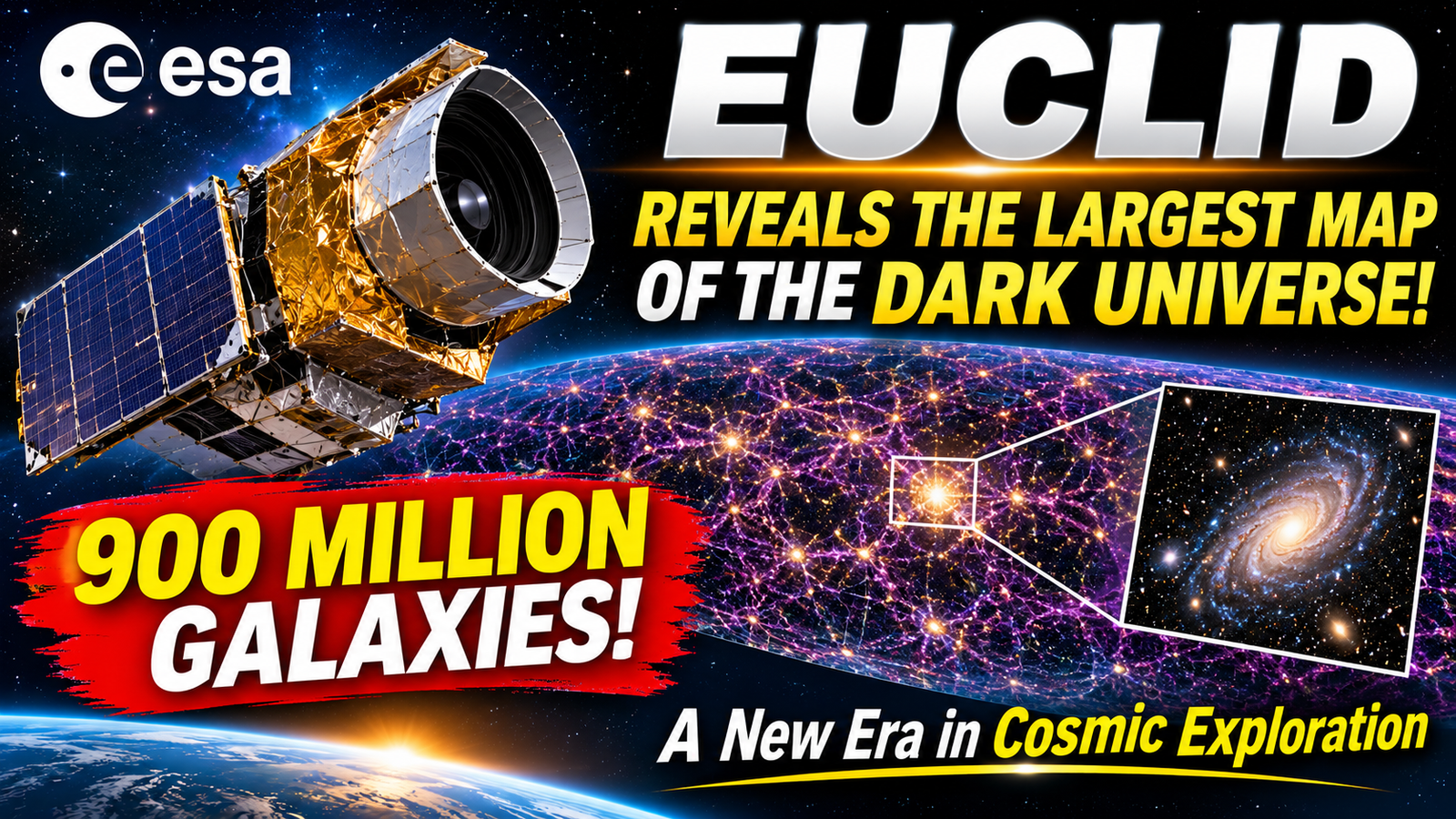
The European Space Agency’s Euclid space telescope has released its first major scientific dataset, capturing more than a billion cosmic objects and laying the foundation for an unprecedented 3D map of the Universe.
Everything we can see in the night sky — every star, planet, galaxy, and nebula — represents only a small fraction of the Universe. According to the standard cosmological model, ordinary matter accounts for roughly 5% of the cosmos. The remaining 95% consists of two mysterious components: dark matter and dark energy.
Neither emits light that telescopes can directly detect, yet both play fundamental roles in the evolution and structure of the Universe.
Now, scientists have taken a major step toward understanding this invisible cosmic landscape. On November 12, 2026, the European Space Agency (ESA) released DR1-Foundation, the first major scientific data release from its Euclid space telescope.
The results are remarkable: more than 900 million galaxies, approximately 15,000 strong gravitational lens candidates, and observations of over a billion cosmic objects.
This is only the beginning of Euclid’s ambitious mission to map the dark Universe.
A Cosmic Survey on an Unprecedented Scale
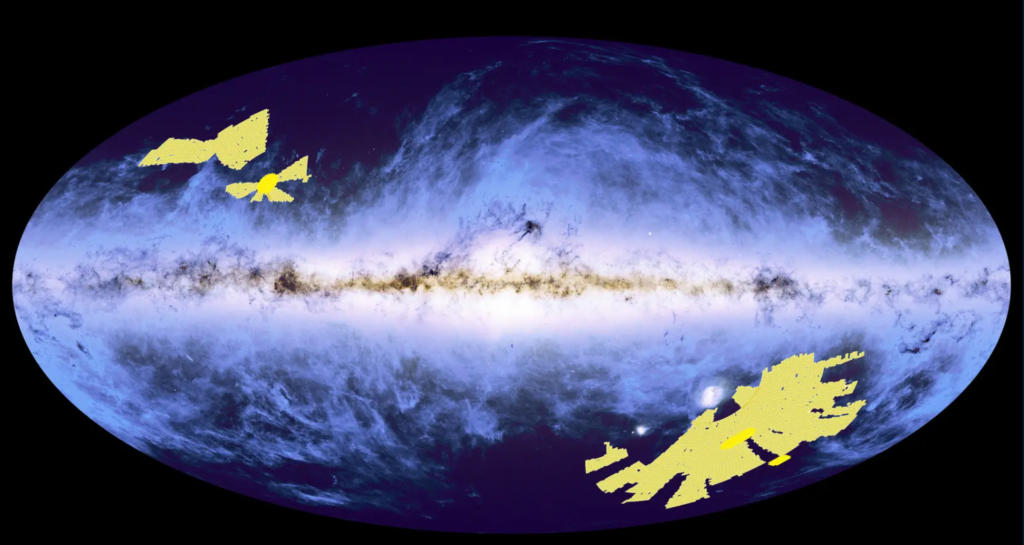
The new dataset combines approximately 13 months of observations, covering an area of the sky equivalent to 9,500 full Moons.
It contains approximately 1.7 petabytes of information, including calibrated images, astronomical catalogs, and spectra. The observations cover around 1,900 square degrees of the sky — a dramatic expansion compared with Euclid’s earlier releases, which included only a few days of observations over approximately 60 square degrees.
Among the highlights are:
- More than 900 million galaxies.
- Around 15,000 strong gravitational lens candidates.
- Over 60 million quasar candidates.
- Spectroscopic data from more than 160 million sources.
- Vast collections of images and catalogs that will support future research.
For the first time, astronomers have access to a dataset large enough to demonstrate Euclid’s true capabilities as a wide-field cosmic survey telescope.
Rather than simply producing beautiful images, Euclid is collecting the measurements needed to reconstruct the large-scale structure of the Universe in three dimensions.
A Nearly 500-Gigapixel Window Into the Cosmos
One of the most impressive elements of the release is an enormous mosaic of the northern sky, containing nearly 500 gigapixels.
The image allows astronomers to explore cosmic structures on an extraordinary range of scales. Zooming into the mosaic reveals details that would otherwise be impossible to appreciate in such a vast survey.
Among the objects featured is Messier 81, a spiral galaxy located approximately 12 million light-years from Earth. With Euclid’s detailed observations, its structure becomes increasingly clear, revealing individual stars and intricate features within the galaxy.
In the southern sky, Euclid also observed the Horologium Supercluster, located roughly 800 million light-years away, as well as the rich galaxy cluster Abell 3128.
The latter provides a particularly fascinating view of gravitational lensing, with blue arcs of light appearing around the cluster’s central region.
These images are not merely spectacular astronomical portraits. They contain valuable clues about how matter is distributed throughout the cosmos.
Gravitational Lensing: Seeing the Invisible Through Gravity
One of the most exciting achievements in the new release is the discovery of approximately 15,000 strong gravitational lens candidates — the largest catalog of its kind ever assembled.
Gravitational lensing occurs when the gravity of a massive object, such as a galaxy or galaxy cluster, bends the light coming from a more distant object behind it.
According to Einstein’s theory of general relativity, mass curves spacetime. As light travels through this curved region, its path is distorted. From our perspective, the background galaxy can appear stretched into bright arcs, distorted shapes, or even nearly complete rings.
<em>These cosmic lenses act like natural telescopes, magnifying objects that would otherwise be extremely difficult to observe.</em>
Strong gravitational lenses are rare. Only a small fraction of galaxies produce the kind of distortion needed for astronomers to identify them as powerful lenses.
Finding approximately 15,000 candidates in a single release is therefore a major achievement.
Euclid’s search combines machine-learning techniques with the contributions of thousands of volunteers from the citizen-science project Space Warps.
These observations offer a powerful way to investigate dark matter. By studying how much a galaxy bends the light from objects behind it, scientists can estimate its total mass — including the invisible matter that cannot be observed directly.
In other words, gravity allows astronomers to investigate something that does not shine.
Quasars: Cosmic Beacons From the Distant Past
The DR1-Foundation dataset also includes more than 60 million quasar candidates.
Quasars are extraordinarily bright objects powered by supermassive black holes at the centers of galaxies. As gas and dust fall toward these black holes, they form extremely hot accretion disks that release enormous amounts of energy.
Some quasars are so luminous that they can outshine all the stars in their host galaxies combined.
Because many are located billions of light-years away, quasars provide valuable information about the early Universe. Their light has traveled across enormous distances, carrying a record of cosmic conditions from the distant past.
By studying these objects, astronomers can investigate how galaxies and their central black holes evolved over billions of years.
Turning Light Into a Three-Dimensional Map
Another essential part of Euclid’s mission involves spectroscopy.
The telescope has obtained spectra from more than 160 million sources. Spectroscopy works by separating incoming light into its different wavelengths, producing something similar to a cosmic rainbow.
This information allows scientists to identify characteristic features in the light emitted by astronomical objects.
One particularly important feature is the spectral signature of hydrogen. By measuring how these features have shifted toward longer wavelengths — a phenomenon known as redshift — researchers can estimate how far away galaxies are and how the Universe has expanded during the journey of their light.
Combining these measurements with the galaxies’ positions on the sky makes it possible to place them within a three-dimensional representation of the cosmos.
The ultimate goal is to reconstruct the cosmic web: an enormous network of filaments, clusters, and vast empty regions that defines the large-scale structure of the Universe.
Dark matter plays a crucial role in this structure. Its gravitational influence helps determine where galaxies form and how they cluster together.
Euclid will use millions of precise observations to investigate this invisible framework and understand how it has changed throughout cosmic history.
What Are Dark Matter and Dark Energy?
The mission’s scientific goals are connected to two of the biggest unanswered questions in modern physics.
Dark matter is an invisible form of matter that does not interact with light in the way ordinary matter does. Its presence is inferred through gravitational effects, including the motion of stars within galaxies, the behavior of galaxy clusters, and gravitational lensing.
Without dark matter, many observed structures in the Universe would be difficult to explain.
Dark energy, meanwhile, is the name given to whatever is driving the accelerated expansion of the Universe.
In the late 1990s, observations of distant supernovae revealed that cosmic expansion is accelerating rather than slowing down under gravity alone.
Although dark energy is commonly associated with the cosmological constant in the standard model, its true physical nature remains unknown.
Euclid will investigate both phenomena by measuring how galaxies are distributed and how their shapes and positions have changed over cosmic time.
Its observations may help scientists determine whether dark energy behaves like a constant property of space or whether its influence changes as the Universe evolves.
The Next Step: A Much Larger Map in 2027
Despite the enormous scale of the DR1-Foundation release, it represents only approximately 14% of the total sky area Euclid is expected to survey during its mission.
The next major milestone is the complete Data Release 1, scheduled for mid-2027.
This release is expected to add important measurements of weak gravitational lensing, complementing the strong lensing candidates already identified.
Unlike strong lensing, which produces dramatic arcs and rings, weak gravitational lensing causes subtle distortions in the apparent shapes of distant galaxies.
By measuring these tiny changes across enormous numbers of galaxies, scientists can reconstruct the distribution of matter on much larger scales — including dark matter.
The next release will also provide additional information about galaxy clusters and the relationship between galaxies and the cosmic web.
These observations will be particularly important as researchers investigate recent questions about the nature of dark energy, including results from the Dark Energy Spectroscopic Instrument (DESI), which have prompted renewed discussion about whether dark energy might evolve over time.
However, these questions remain under investigation. Euclid’s future measurements will be essential for testing competing explanations.
Euclid Is Just Getting Started
Launched in July 2023, the Euclid mission began its routine scientific observations on February 14, 2024.
Built and operated by the European Space Agency, with contributions from NASA and an international scientific collaboration, the telescope was designed to observe billions of galaxies and measure distances to millions of them.
Its mission is ambitious: investigate the dark components of the Universe and trace the evolution of cosmic structures over approximately the last 10 billion years.
The release of DR1-Foundation marks a turning point. For the first time, astronomers have access to an enormous collection of observations that can be used to investigate rare cosmic objects, measure gravitational effects, and begin assembling a detailed three-dimensional map of the cosmos.
Yet the most exciting discoveries may still be ahead.
With only a fraction of its planned survey completed, Euclid is already revealing an extraordinary amount about the Universe. As the dataset grows, scientists will gain increasingly precise tools to investigate the invisible forces and structures that shape everything we see.
The Universe may be mostly invisible, but thanks to Euclid, we are beginning to map it in unprecedented detail.
Image Credit: ESA/Euclid/Euclid Consortium/NASA. Image processing by J.-C. Cuillandre and E. Bertin. CC BY-SA 3.0 IGO.
Primary Source: European Space Agency (ESA) — Euclid lays the foundation for its best-ever 3D map of the Universe.


Окей, расскажу свою маленькую игровую драму.
Я альтушка с черной подводкой,
растрепанной челкой и
вечными наушниками на шее. Со стороны кажется, что я живу ради рейтинга, но на самом деле мне
хочется произвести впечатление
на парней из нашей компании. И да, играю я объективно так себе,
особенно когда начинается настоящая
заварушка.
В последнее время постоянно
запускаю Valorant, потом переключаюсь на Deadlock,
а ближе к ночи могу пропасть в PUBG.
Игры обожаю, но с реакцией у меня какая-то комедия:
могу промазать по противнику в
упор. Раньше мне говорили
«тебе бы в тренировку», а теперь в голосовом чате почему-то уверены,
что я тайно тренируюсь по восемь часов.
Смешно, потому что иногда я даже путаю кнопки после нового маникюра.
Сразу скажу честно, без читов мой рейтинг выглядел бы совсем иначе.
Не для того, чтобы читать кому-то лекции про
скилл, просто мне надоело слышать вздохи после каждого моего
промаха. С ними у меня внезапно начали получаться такие красивые хайлайты,
что друзья просят скинуть запись.
Я, конечно, делаю серьезный
голос и говорю: «Да это просто хороший
день». Потом выключаю микрофон и
смеюсь в подушку.
Самое абсурдное случилось на прошлой неделе.
После очередного матча мне
прилетело неожиданное
сообщение. Оказывается,
меня хотели позвать на просмотр в женскую киберспортивную команду!
Я даже сначала решила, что это
розыгрыш. Мне рассказывали про капитана, стратегию, роли
и постоянные тренировки. А я в этот момент думала,
успею ли в субботу в торговый центр, потому что там открыли новую кофейню
с милыми стаканчиками.
Вот такая из меня будущая звезда киберспорта.
Я бы скорее провела вечер с мальчиками в ТЦ,
чем сидела на разборе демок. Мне
нравится, когда в чате пишут «вау, как ты это сделала», а потом кто-нибудь предлагает вместе
сходить за бабл-ти. Еще теперь
меня зовут в разные пати, и я каждый раз устраиваю маленький кастинг
не по рангу, а по чувству юмора.
Даже самый высокий рейтинг не спасет парня,
который скучно общается и игнорирует мои
мемы. Мне вообще кажется, что хороший
вечер определяется не количеством побед, а тем, с кем
потом гуляешь по городу. Но иногда становится немного стыдно: они думают, что я настоящий
талант, а я знаю, сколько там моего собственного скилла.
Может, однажды научусь играть нормально
и перестану хитрить. А пока у меня идеальная стратегия на вечер: сначала рейтинг,
потом новые серьги и прогулка с компанией.
I’m not sure where you’re getting your info, but good topic.
I needs to spend some time learning much more or understanding more.
Thanks for great information I was looking for this info for my mission.
Do you have a spam issue on this website; I also am
a blogger, and I was curious about your situation; many of us have developed some
nice practices and we are looking to swap strategies with others, please shoot
me an email if interested.
This article will assist the internet people for setting up new
blog or even a blog from start to end.
Excellent post. I used to be checking continuously this blog and I’m inspired!
Very useful information particularly the remaining phase
🙂 I handle such information much. I used to be
seeking this certain info for a very long time. Thanks and best
of luck.
I know this site presents quality based articles
and additional stuff, is there any other web site which
presents these things in quality?
References:
Sofort Casino No Deposit Bonus https://instapages.stream/story.php?title=casino-bonus-ohne-einzahlung-aktuelle-top-angebote-2026
Thank you, I’ve just been looking for info approximately this subject for
a long time and yours is the best I’ve came upon so far.
But, what in regards to the conclusion? Are you certain in regards to the supply?
Whats up are using WordPress for your site
platform? I’m new to the blog world but I’m trying to get started and set up my own. Do you
require any coding expertise to make your own blog? Any help would be greatly
appreciated!