

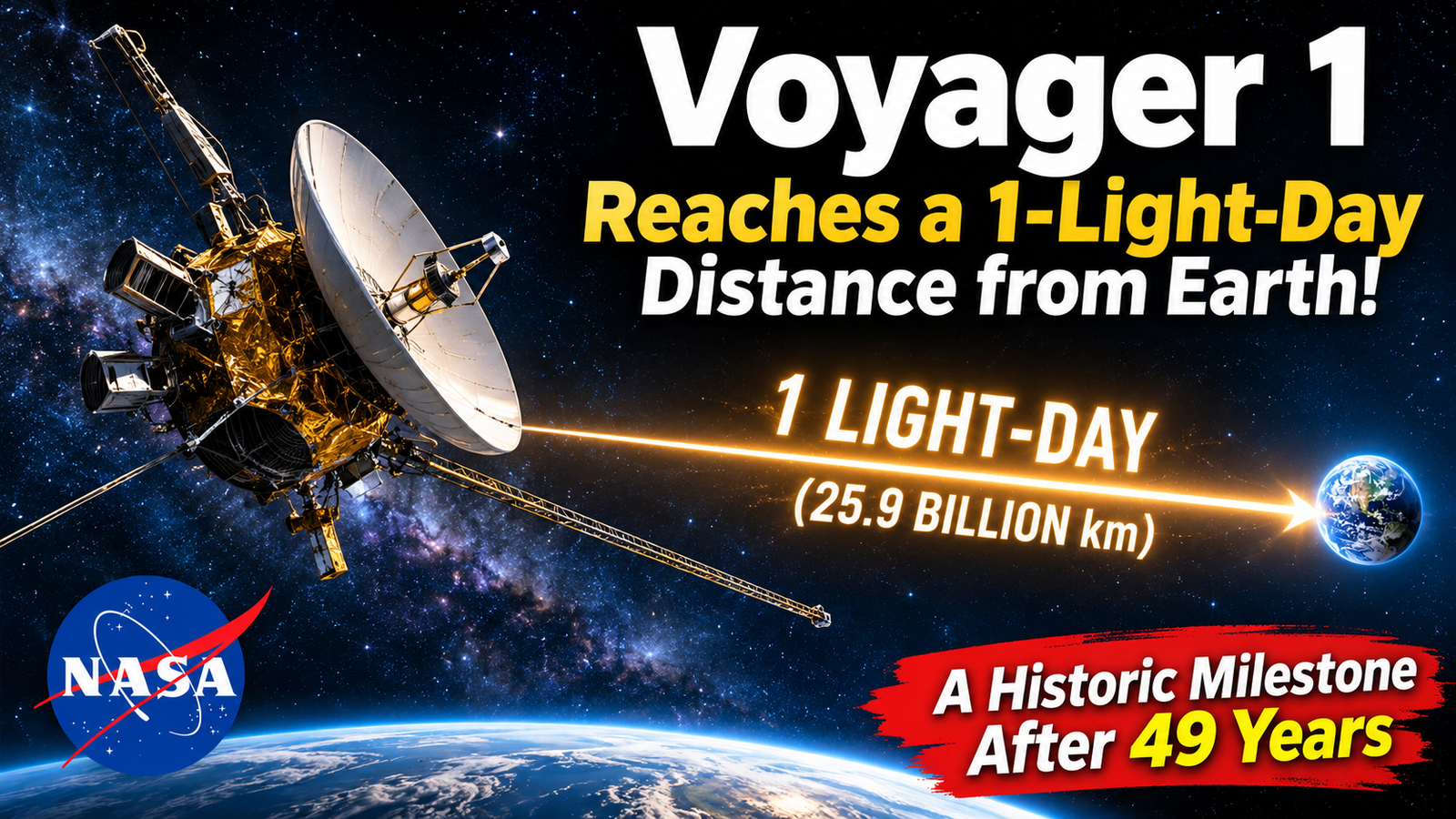
After nearly five decades traveling through space, NASA’s most distant spacecraft is about to reach a remarkable milestone. On November 18, 2026, Voyager 1 will become the first human-made object to reach a distance of one light-day from Earth — approximately 25.9 billion kilometers away.
Imagine sending a message to a spacecraft and having to wait an entire day just for it to arrive. Then imagine waiting another day for the reply.
That is about to become the reality of communicating with NASA’s Voyager 1.
Launched on September 5, 1977, this remarkable spacecraft has spent nearly 50 years traveling farther from Earth than any other human-made object. Now, it is approaching a new milestone in space exploration: reaching a distance of one light-day from our planet.
According to NASA, Voyager 1 is expected to cross this threshold on Wednesday, November 18, 2026, at approximately 5:16 a.m. Eastern Time.
The distance involved is staggering: around 25.9 billion kilometers (16.1 billion miles).
But what exactly is a light-day? Why is this milestone so important? And how can NASA still communicate with a spacecraft that is so incredibly far away?
What Exactly Is a Light-Day?
Most people have heard of a light-year, a unit astronomers use to describe enormous distances across the universe.
A light-year is the distance light travels in one year. A light-day follows exactly the same principle, except that it measures how far light travels in 24 hours.
Light moves through a vacuum at approximately 300,000 kilometers per second (186,000 miles per second). Over an entire day, that adds up to approximately:
25.9 billion kilometers, or 16.1 billion miles.
In other words, when Voyager 1 reaches the one-light-day mark, a radio signal traveling from Earth to the spacecraft will need approximately 24 hours to get there.
This is a distance milestone, not a measure of how long the spacecraft has been traveling.
To put the scale into perspective, consider some familiar objects in our cosmic neighborhood.
- The Moon: Light takes approximately 1.3 seconds to travel from Earth to the Moon.
- The Sun: Sunlight takes about 8 minutes and 20 seconds to reach Earth.
- Mars: Depending on the planets’ positions in their orbits, light takes roughly 3 to 22 minutes to travel between Earth and Mars.
- Neptune: Light takes approximately four hours and ten minutes to travel between Earth and the Solar System’s most distant major planet.
Now consider Voyager 1: its distance from Earth is so great that light itself needs an entire day to cover the gap.
That is an extraordinary achievement for a spacecraft launched almost half a century ago.
How Did Voyager 1 Travel So Far?
Voyager 1 began its journey in 1977 as part of NASA’s ambitious Voyager program, which included two spacecraft designed to explore the outer Solar System.
Its original mission focused on studying Jupiter and Saturn, two giant planets that had remained largely unexplored by spacecraft at the time.
Voyager 1 successfully flew past Jupiter in 1979 and Saturn in 1980, sending back extraordinary images and scientific measurements that transformed our understanding of these distant worlds.
After completing its planetary encounters, the spacecraft followed a trajectory that sent it away from the planets and toward interstellar space.
Its twin, Voyager 2, followed a different path. It continued beyond Saturn to explore Uranus and Neptune, becoming the first and only spacecraft to visit those two ice giants up close.
Both spacecraft eventually continued outward, far beyond the familiar planetary region of the Solar System.
But Voyager 1 would become the first to cross another important boundary.
Voyager 1 Has Already Entered Interstellar Space
In August 2012, Voyager 1 made history by crossing the heliopause, the outer boundary of the heliosphere.
The heliosphere is a vast bubble surrounding the Sun, created by the solar wind — a continuous flow of charged particles released by our star.
As the solar wind travels outward, it encounters the material filling interstellar space. The region where the Sun’s influence in the form of solar wind gives way to the surrounding interstellar environment marks the heliopause.
By crossing this boundary, Voyager 1 became the first human-made spacecraft to enter interstellar space.
Its twin, Voyager 2, followed in November 2018.
However, there is an important distinction: entering interstellar space does not necessarily mean leaving the Solar System entirely.
The Sun’s gravitational influence extends much farther than the heliosphere. One of the most distant regions associated with our Solar System is the Oort Cloud, a vast and largely unexplored reservoir of icy objects believed to surround the Sun.
Depending on how we define the outer boundary of the Solar System, Voyager 1 still has an incredibly long journey ahead.
NASA estimates that the Voyager spacecraft could take approximately 40,000 years to reach the region considered the outer edge of the Sun’s gravitational domain.
So, despite its historic journey, Voyager 1 has not completely escaped the Sun’s gravitational influence.
How Can NASA Still Communicate With Voyager 1?
One of the most fascinating aspects of the Voyager mission is that the spacecraft continues to communicate with Earth despite its enormous distance.
How is that possible?
Voyager 1 uses a high-gain antenna to transmit radio signals toward Earth. These signals are electromagnetic waves, just like visible light, and travel through space at the speed of light.
However, because the spacecraft is so far away, even these incredibly fast signals need approximately 24 hours to reach us.
The same delay applies in the opposite direction.
If NASA sends a command to Voyager 1, the signal takes about one day to arrive. If the spacecraft then sends a response, that transmission needs another day to return.
This means a simple communication exchange can take almost 48 hours.
NASA relies on the Deep Space Network (DSN), a global system of powerful radio antennas designed to communicate with spacecraft exploring the distant reaches of space.
These antennas are located in California, Spain, and Australia. Together, they provide coverage as Earth rotates, allowing NASA to maintain contact with distant missions.
Receiving Voyager’s signals is no easy task. By the time they reach Earth, they are extraordinarily weak, so the network must use highly sensitive equipment to detect and process them.
The time required for the signals to travel also helps scientists determine the spacecraft’s distance from Earth.
Where Is Voyager 1 Heading?
Voyager 1 is traveling in the general direction of a star known as Gliese 445, also designated AC +79 3888.
The star is located in the constellation Ursa Minor and is currently more than 17 light-years away from Earth.
The spacecraft is expected to pass within approximately 1.7 light-years of it in around 40,000 years.
That might sound like an extraordinary close encounter, but there is no chance of Voyager 1 reaching the star itself.
The spacecraft is moving at approximately 61,000 kilometers per hour (38,000 miles per hour). That is incredibly fast by everyday standards, but relatively slow compared with the speed of light.
Even after traveling for tens of thousands of years, Voyager 1 will remain a long distance from Gliese 445.
Its journey is a reminder of just how vast the distances between stars really are.
What About Voyager 2? When Will It Reach One Light-Day?
Voyager 1 is not the only spacecraft traveling through interstellar space.
Its twin, Voyager 2, is also continuing its journey beyond the heliosphere, although it is following a different trajectory and traveling at a different speed.
NASA estimates that Voyager 2 will reach the one-light-day distance from Earth in November 2035, approximately nine years after Voyager 1.
Both spacecraft carry the famous Golden Record, a collection of sounds, images, music, and greetings from Earth intended as a symbolic message to any extraterrestrial civilization that might someday encounter them.
The records include natural sounds, human voices, music from different cultures, and information about our planet and its inhabitants.
Although the chances of either spacecraft being discovered by another civilization are extremely uncertain, the Golden Records represent humanity’s desire to communicate with the unknown.
A Message From Earth That Takes a Day to Arrive
When Voyager 1 reaches the one-light-day milestone on November 18, nothing dramatic will happen aboard the spacecraft.
It will not cross a physical barrier, encounter a new region of space, or suddenly change its scientific mission.
The importance of this achievement is symbolic — and extraordinary.
For the first time, a human-made object will be so far from Earth that even light needs a full 24 hours to travel between the spacecraft and our planet.
Nearly 50 years after launch, Voyager 1 continues to demonstrate how far human exploration can reach.
And while its scientific instruments will not operate forever, the spacecraft itself is expected to continue drifting through interstellar space long after its communication with Earth eventually ends.
One day, Voyager 1 may become a silent messenger traveling among the stars, carrying a small record of the civilization that built it.
For now, however, NASA still has a connection with its distant explorer.
And on November 18, that connection will span an entire light-day.
Hello! This post couldn’t be written any better!
Reading through this post reminds me of my previous room mate!
He always kept talking about this. I will forward this article to
him. Pretty sure he will have a good read. Thanks for sharing!
References:
Echtgeld casino sofortüberweisung https://rentry.co/u2gfhxub
you are actually a good webmaster. The site loading pace is amazing.
It seems that you’re doing any unique trick.
Moreover, The contents are masterwork. you have done a magnificent
job on this topic!
This website was… how do you say it? Relevant!! Finally I have
found something which helped me. Many thanks!
Especially interesting….looking ahead to visiting again.
https://ddtorun.pl/pl/
I have been browsing online more than 2 hours today, yet I never found any interesting article like
yours. It’s pretty worth enough for me. In my opinion, if all web owners
and bloggers made good content as you did, the web will
be much more useful than ever before.
pop108 menawarkan kepada Anda koleksi permainan slot online yang lengkap dengan pilihan slot gacor dari berbagai tema.
Anda dapat menikmati permainan slot dengan aturan jelas dan fitur yang mudah dipahami, cocok untuk pemain baru maupun yang sudah berpengalaman. Situs ini menyediakan akses cepat ke semua permainan melalui antarmuka
yang sederhana. Anda juga mendapatkan kenyamanan bermain melalui perangkat mobile dengan tampilan yang menyesuaikan layar.
Setiap permainan di pop108 dapat dimulai dalam hitungan detik
setelah Anda masuk ke akun.
Hello mates, nice paragraph and nice urging commented at
this place, I am really enjoying by these.
Hi there! This is my first visit to your blog! We are a group of volunteers
and starting a new initiative in a community in the same niche.
Your blog provided us valuable information to work on. You have done a extraordinary job!
fantastic post, very informative. I’m wondering why the opposite specialists of this sector do
not understand this. You should proceed your writing.
I’m confident, you’ve a huge readers’ base already!